Before You Call Us
Your home and workplace should be places of confidence, not uncertainty. Here's what you should know about asbestos — and how to prepare for your inspection.
Residential Asbestos Testing
Your home and workplace should be places of comfort and confidence — not uncertainty. We provide professional asbestos testing across Southern Vancouver Island and the Gulf Islands, delivering clarity when it matters most.
Our inspections are performed in full accordance with provincial regulations, ensuring your project moves forward safely and compliantly. If your building was constructed before the 1990s, asbestos testing is required prior to any renovation or disturbance. Taking this step early protects both your health and your investment.
When disturbed, asbestos fibres can linger in the air for hours — even days. Exposure carries serious, irreversible health risks. That's why careful planning and accurate testing are essential.
Before reaching out, we encourage you to review your renovation plans to identify the materials involved. A little preparation allows us to provide precise guidance and the exact testing you need — saving you time while ensuring nothing is overlooked.
⚠ Health Risk — Do Not Disturb
If you suspect a material contains asbestos, do not disturb it until it has been tested. Even small disturbances can release fibres. Asbestos exposure is linked to:
- Mesothelioma (lung lining cancer)
- Asbestosis (lung scarring)
- Lung cancer
- Pleural disease
⚠ BC Regulation Requirement
Under WorkSafe BC regulations, asbestos testing is legally required before any renovation or demolition of buildings constructed prior to 1990. Non-compliance can result in serious fines and project shutdowns.
Where Asbestos Is Commonly Found
Asbestos was widely used in building materials before the early 1990s. It can be found in many places — some obvious, some hidden. The materials listed below commonly contain asbestos in pre-1990 buildings.
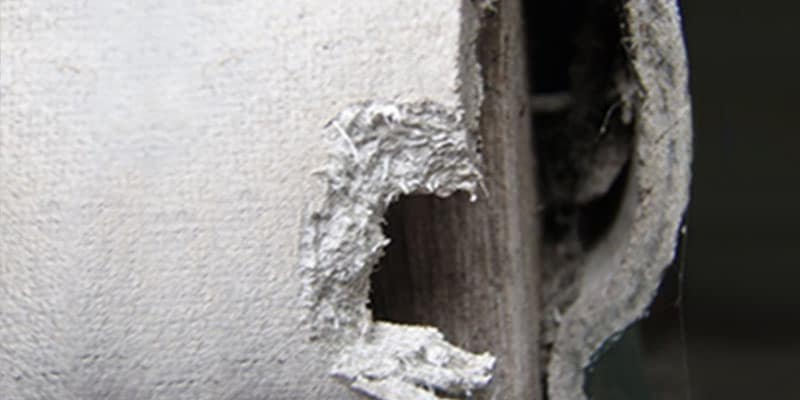
Deteriorating asbestos insulation — do not disturb before testing
Floor tiles & vinyl flooring adhesive
Ceiling tiles (acoustic & drop)
Popcorn / textured ceiling spray
Joint compound & drywall tape
Pipe insulation & lagging
Boiler & furnace insulation
Attic insulation (Zonolite / vermiculite)
Roof shingles & roofing felt
Exterior siding (transite panels)
Window glazing & caulking
Electrical panels & wiring insulation
Duct wrapping & HVAC insulation
Spray-applied fireproofing
Plaster & stucco finishes
Concrete board & millboard
Linoleum backing
Not Sure If Your Material Is at Risk?
You cannot tell if a material contains asbestos by looking at it. Only laboratory analysis can confirm it. When in doubt — test it before you touch it.
How to Prepare Before Calling
The more information you have ready, the faster we can recommend the right inspection and get it booked.
Know Your Building Age
Find out when your building was constructed. Buildings built before 1990 are most likely to contain asbestos materials. The exact year helps us determine the likelihood and scope of any asbestos presence.
Identify Your Renovation Scope
Write down which areas and materials will be disturbed during your renovation. The more specific you can be (e.g., "removing 200 sq ft of vinyl flooring in the kitchen"), the more accurate your quote will be.
Note Visible Damage or Deterioration
Take note of any materials that appear damaged, crumbly, or deteriorating. Friable (crumbly) materials are a higher priority and may require more urgent attention even before renovation begins.
Plan for Access
Our inspector will need access to all areas being tested, including attics, crawlspaces, and mechanical rooms. If these areas are locked or difficult to reach, let us know in advance so we can plan accordingly.
What to Tell Us When You Call
Having this information ready will help us match you with the right inspection type and provide an accurate quote:
- Year of construction (approximate is fine)
- Type of property (home, strata, commercial)
- What work is planned and which materials
- Size of the area being worked on
- Whether any materials appear damaged
- Your desired timeline / project start date
- Whether rush results may be needed
DIY Sampling Option
For basic testing on easily accessible materials, we offer a guided at-home sampling option. You collect the sample following our safe protocol, and we analyze it in our certified lab.
How to Sample at HomeReady to Move Forward?
Contact us today — we'll help you understand exactly what testing you need and get your project moving safely.